Other Information
Drive times from Deanland to following locations:
Deanland Airfield is very close to a designated Area of Outstanding Natural Beauty and the South Downs National Park: as such it is the intention of the Operators that the airfield be a part of that Area, rather than an imposition upon it. Two separate, but complementary, considerations must be acknowledged, in order to achieve that aim — namely, Physical Aspects and The Perceptions of the Local Community.
Physical Aspects
Within its boundaries, the airfield contains areas of woodland, natural hedging and coarse meadowland. Generally, the land is maintained with the minimum use of pesticides and other intrusive control methods, although some light spraying may be used in order to keep the hay-crop clear of weeds, which might be harmful to livestock.
The Operators have planted trees, placing emphasis upon those which would occur naturally in the English countryside; the growth of indigenous species such as Hawthorn/Blackthorn, Oak, Ash, Beech, Elm, etc. is encouraged.
The site is a haven for many species of insect — bees, butterflies and dragonflies are particularly prolific — and a good variety of birdlife; the resident nightingale chorus (up to late May) has been described as “the best for miles.” There are also barn- and tawny-owls, marsh- and hen-harriers, swifts, swallows and martins in late spring. In 2000 a pair of buzzards were seen over the Eastern Meadow.
Ground-nesting birds are protected: the hay is never cropped until after their fledging cycle; as a result Deanland boasts a healthy population of skylarks.
The mammal population includes many varieties of mouse (though no dormouse has been recorded yet), plus stoat, weasel, badger, shrew, field-vole and several species of bat (mostly pipistrelle). The largest mammal population is rabbits: although they sometimes cause damage to the airfield, they also invade surrounding crop fields. Their numbers are partly controlled naturally by the local fox population; if populations become too high, shooting may take place — but only when there is no significant human activity at Deanland.
The Perceptions of the Local Community
Deanland has been an active airfield since WWII and operates under a “Certificate of Lawful Use.” It is the policy of the Operators to listen to their neighbours and act upon local feedback, where possible. In 1993, to protect the airfield’s long-term future, an agreement was made with a neighbour and the local authority to prohibit flex-wing microlights using the airfield.
The Operators recognise that some individuals may oppose light aviation generally — especially in the local area (the “Ripe” area). To maintain balance and transparency, they communicate openly with the Parish Council, the County Council (ESCC), and local property owners.
Deanland has contributed to local issues such as land-raise campaigns, and the airfield has been used by Sussex Police / Air Ambulance helicopters when required — forming a useful part of the local social fabric.
Since the 1960s, Deanland has hosted regular “Fly-Ins” and BBQs — inviting aircraft from across the UK and abroad. These events raise money for charities (including WWF and RAFA). Microlight training has taken place at Deanland since 2000, first by Southern Light Flyers, now by Flight Sport Aviation. Many local people have learned to fly from the airfield.
Model-flying (both powered and gliding) has also been carried out at Deanland since the 1960s — controlled under the auspices of Eastbourne Model Flying Club (EMFC).
Aircraft Noise / Low Flying
The area between Hailsham and Lewes sees significant aviation activity. Several small airstrips (at Laughton, Hailsham, Boship, Horsebridge, Swanborough) operate under the “28-day rule,” plus there is a busy gliding site at Ringmer. Low-level military aircraft also regularly use the skies over this region. On top of that, flying clubs from Shoreham use the area for forced-landing practice and aerobatics.
Because of this, aircraft from Deanland are encouraged to spend as little time as possible operating over this area. No aircraft from Deanland will ever conduct low passes or aerobatics locally, except on the very occasional “event day,” and then only centered on the airfield and for a short period.
The airfield operators do not have legal power to police the skies (nor do local authorities) — airspace regulation is the domain of the Civil Aviation Authority (CAA). If someone witnesses an aircraft flying illegally, they are advised to note the registration number (which is legally required to be large and legible if the plane is below 500 feet) and report it via the CAA website: that will identify the registered owner, to whom a complaint may be made.
Summary
- All visitors and residents must respect the environment (e.g., take away and appropriately dispose of waste). Wherever possible, the airfield and surrounding area should be enhanced.
- All aviation activity to/from Deanland must be conducted in a noise-sensitive manner. Full compliance with all Noise Abatement Procedures is mandatory. Failure by pilots to comply will result in them being banned from returning or operating at Deanland. (Full procedures are on the “Pilot Info” page and must be read, understood and complied with.)
Deanland aims to be part of the local community rather than an imposition. The airfield has supported local campaigns (like opposing land-raise), leveraging its status as a “historic site."
The airfield has built links with local groups: Scout and Air-Scout groups in Hailsham & Ringmer, the Eastbourne Army Reserve, local astronomy clubs, and is open to developing further relationships. Many young people have experienced their first flights via the “Young Eagle” scheme.
The airfield has also supported local infrastructure: it is frequently used by the Sussex Police helicopter and welcomes the Sussex Air Ambulance when needed. On many occasions, the airfield has been used for specialist training by Sussex Police (firearms & dog departments). Since 2000, microlight-flying training has been ongoing, and Deanland has even featured in several TV shows and films in this capacity.
Historically, a portion of visitor landing fees has been donated to charity, and special events have raised additional funds. Charities that have benefited include WWF and RAFA; currently, the airfield supports:
Sussex Surrey & Kent Air Ambulance
The airfield remains keen to engage with local schools and youth groups to promote its history and aviation interest. According to the site: in 2018 local groups were being contacted to organise airfield visits and talks. Many people from the local area have learnt to fly at Deanland, in idyllic surroundings.
Should you wish to discuss a project for a group, the current operators encourage contact.
To minimise noise and environmental impact, Deanland enforces strict noise-abatement procedures and takes decisive action against visitors who don’t conform. Although they have no legal authority over all aircraft operating in the area, they can signpost complainants to the CAA if someone believes an aircraft is flying illegally. No aircraft from Deanland will ever do low passes or aerobatics locally — except on occasional, controlled “event days.”
We are very proud that model flying, both power and gliding, has been carried out at Deanland for in excess of 41 years.
Only the long established Eastbourne Model Flying Club (EMFC) may use the site and all model flying is done under their auspices on specified days and times.
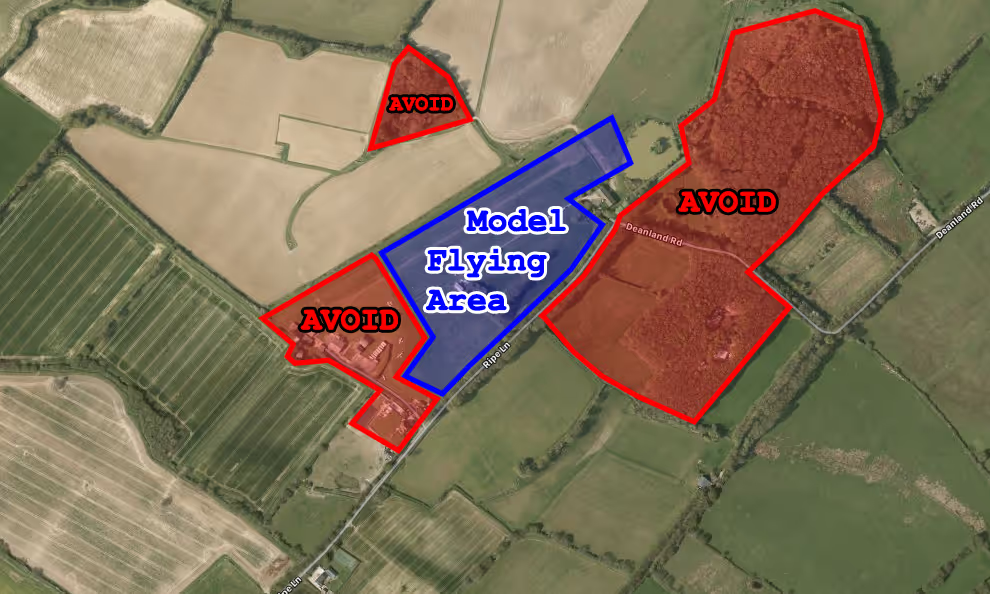
EMFC have laid down rules and procedures which must be complied with at all times. All people flying models must be fully insured. As suggested by the CAA under CAP658, Deanland Airfield LLP has determined a ‘designated flying area’ for models which can be seen on the chart above highlighted in Blue.
Full size aircraft have priority over models at all times and the model flyers are required to monitor the Deanland radio frequency when flying.
The woods and areas highlighted in Red must never be overflown.
Contact for EMFC: shaun@saltwood35.co.uk
Website: www.edmfc.co.uk